
Reproduce the bug
Point your app, phone or emulator at Charlotte. It decrypts the HTTPS and keeps the whole session.
HTTPS debugging proxy · MCP server
Charlotte captures the HTTPS your app actually sent, then hands it to your coding agent over MCP. Claude Code, Copilot and Cursor can search a whole session, open any request and response, replay it, and change the traffic — without you pasting a single header into a chat window.
Loopback only · Role-scoped tokens · Write tools off by default · No cloud inference
The request fails. You copy the cURL out of devtools, paste it into a chat window, and the model reasons about your description of the request — which is exactly the thing that is wrong, most of the time.
Point your app, phone or emulator at Charlotte. It decrypts the HTTPS and keeps the whole session.
“The login call is coming back 401 — look at what Charlotte actually captured and tell me what's wrong.”
It calls search_flows for status:401, opens the flow, and finds the header you got wrong.
list_flows · get_flow — page through captures, open any request in fullsearch_flows — status:>=400, host:*.stripe.com, body:"token"stats · audit_session — totals, hosts, and a security audit as Markdownreplay_flow — re-send a captured request, with or without changescreate_rewrite · create_map_local — change headers, bodies, or serve from diskset_breakpoint — pause matching traffic so it can be edited in flight127.0.0.1 and is never exposed to the network. Charlotte has no
backend, no account and no telemetry — there is no server to send your traffic to.
Charlotte ships on Windows today. The macOS app is built on the same capture engine and is coming soon.
macOS Coming soon
Inspect macOS traffic, review request bodies, and work through device and simulator sessions without leaving the app.
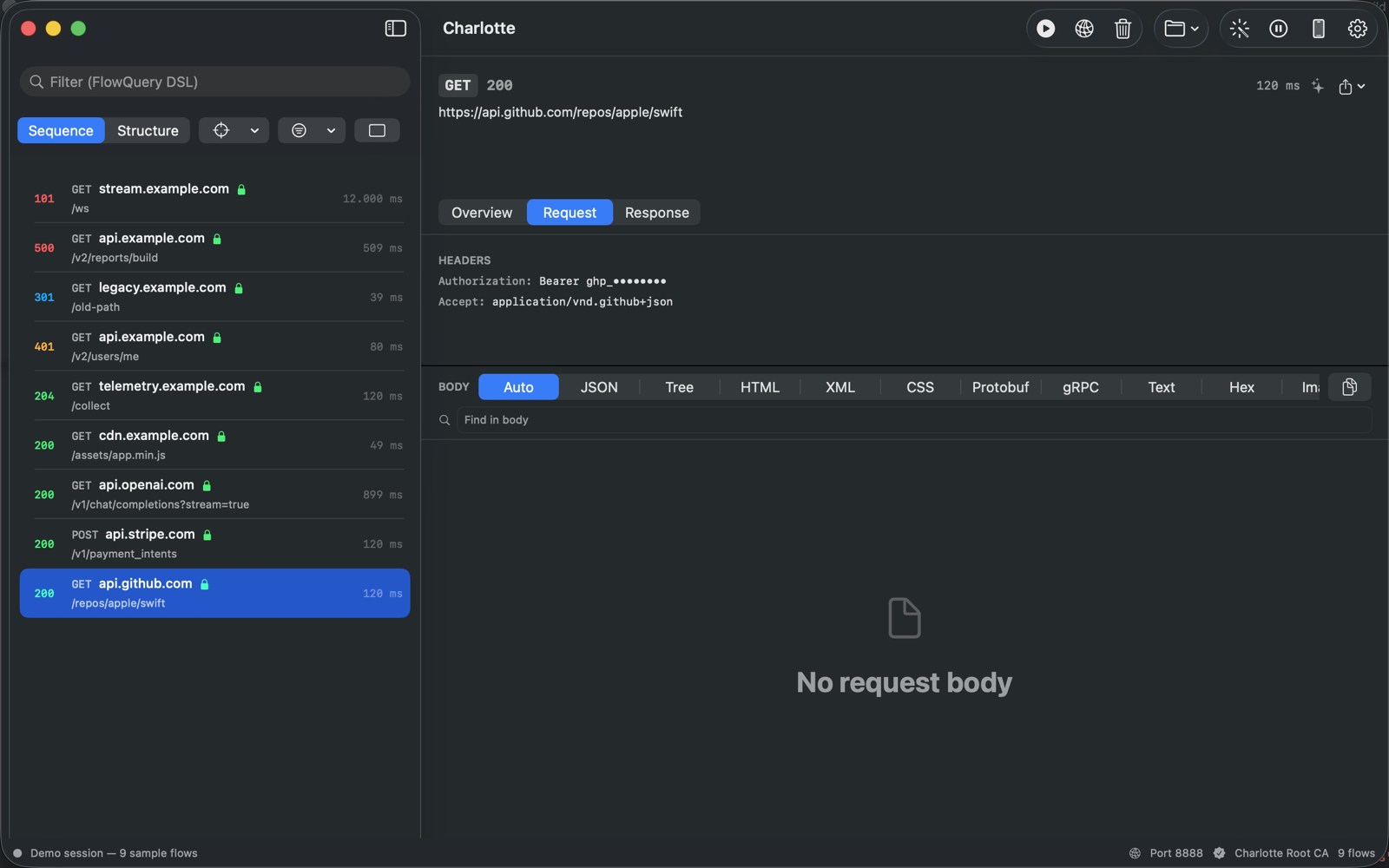
Windows
Use Charlotte to watch requests from Windows desktop apps, reproduce flaky network conditions, and verify releases before they ship.
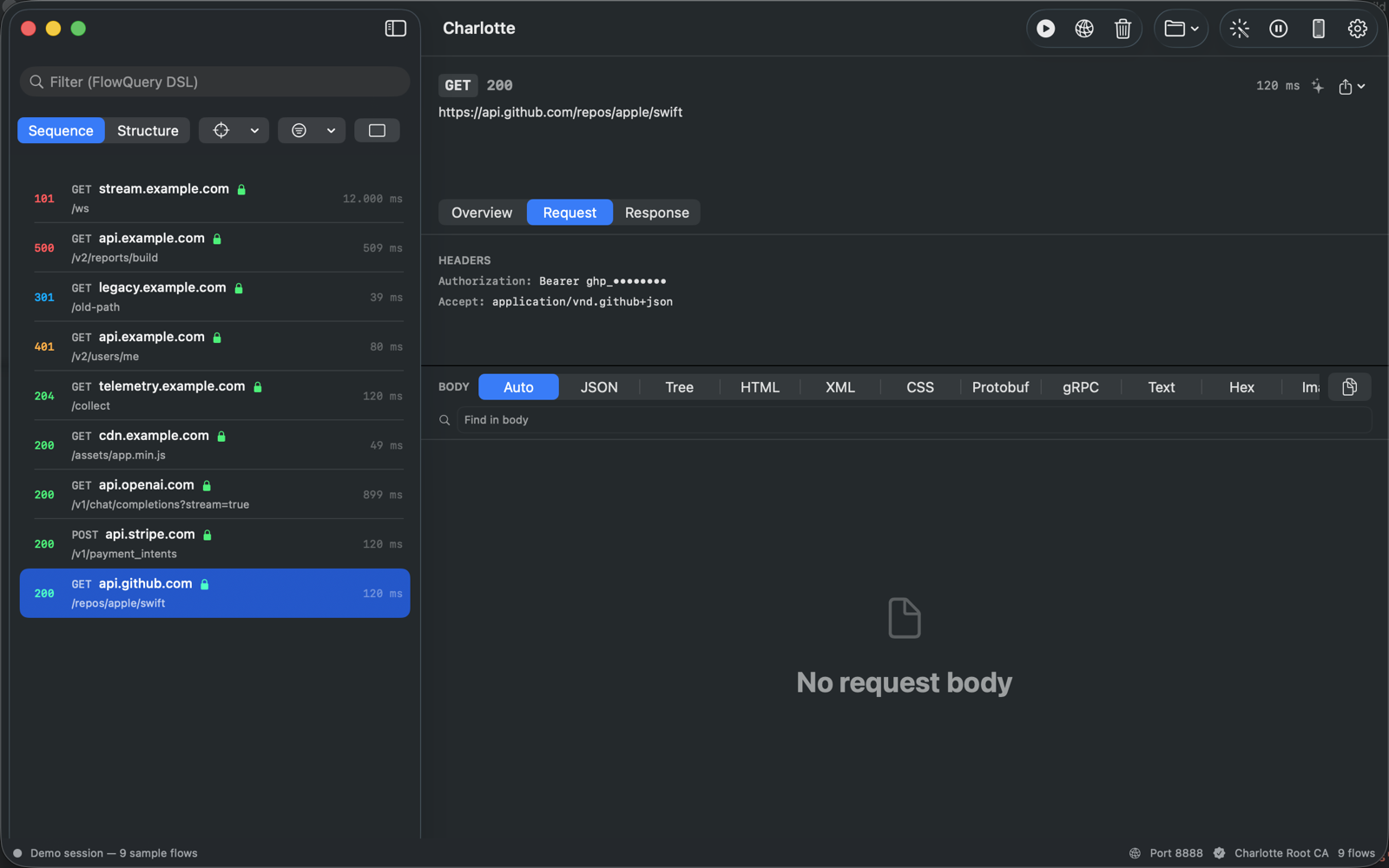
A focused desktop toolset for developers and QA teams — no Electron, no cloud round-trips.
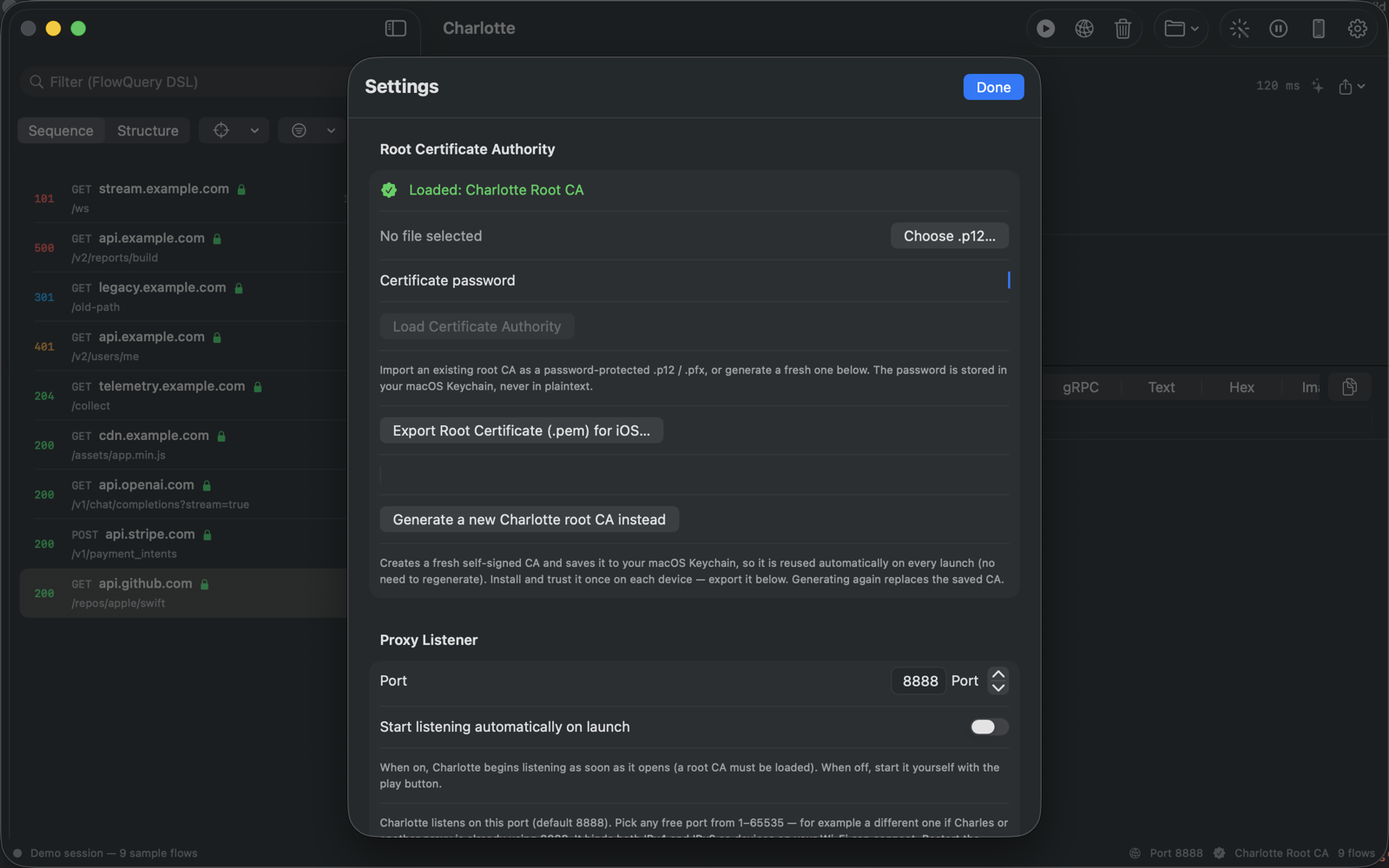
Terminate TLS as a proxy with a root CA Charlotte generates (or one you import). Read HTTP/1.1, HTTP/2 per-stream, and WebSocket frames.
Auto, JSON, Protobuf, Text, and Hex views with gzip / deflate decoding, so you always see the real payload.
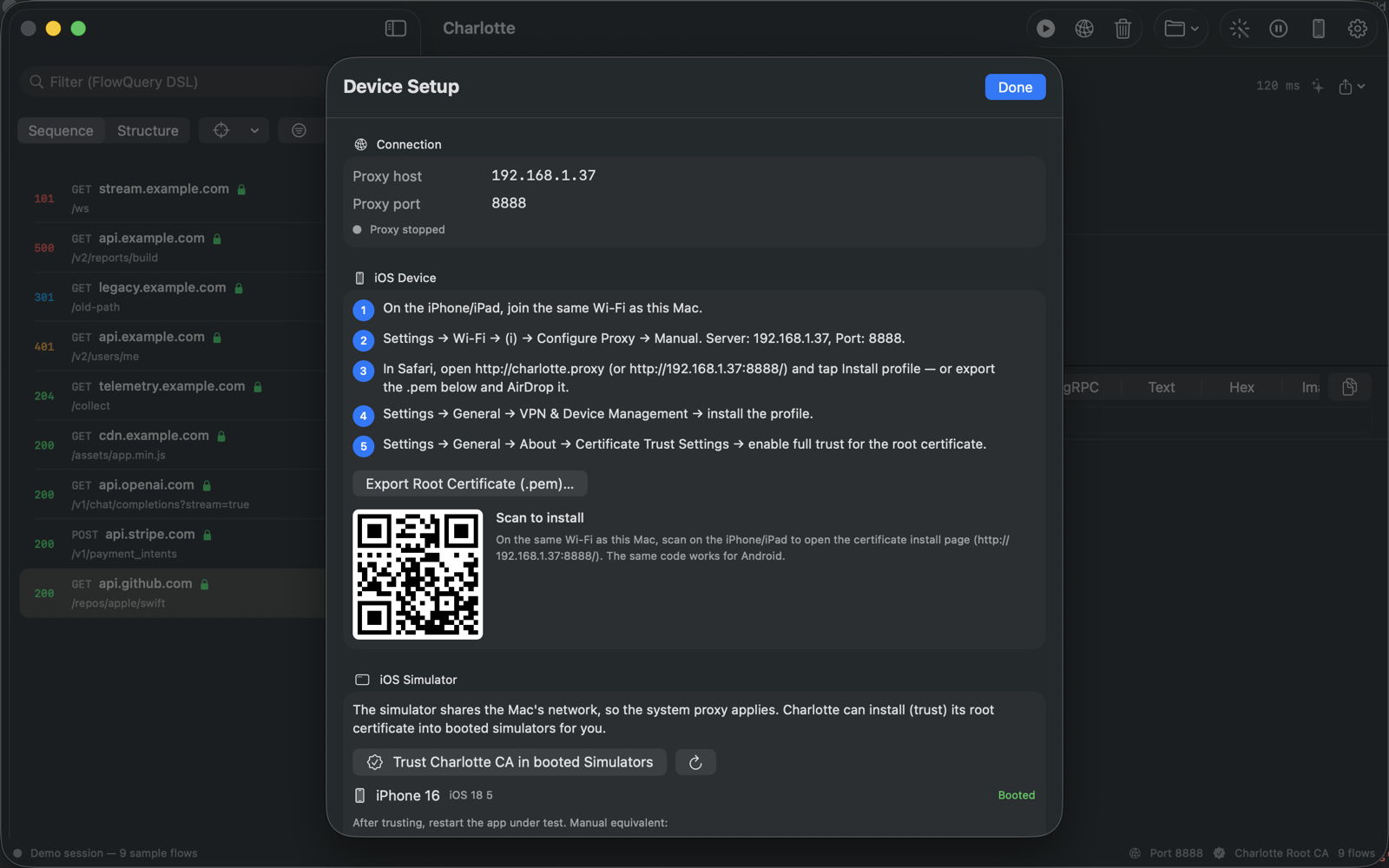
Guided setup for iOS devices, the iOS Simulator, and Android emulators — including one-click cert install and a QR code for physical devices.
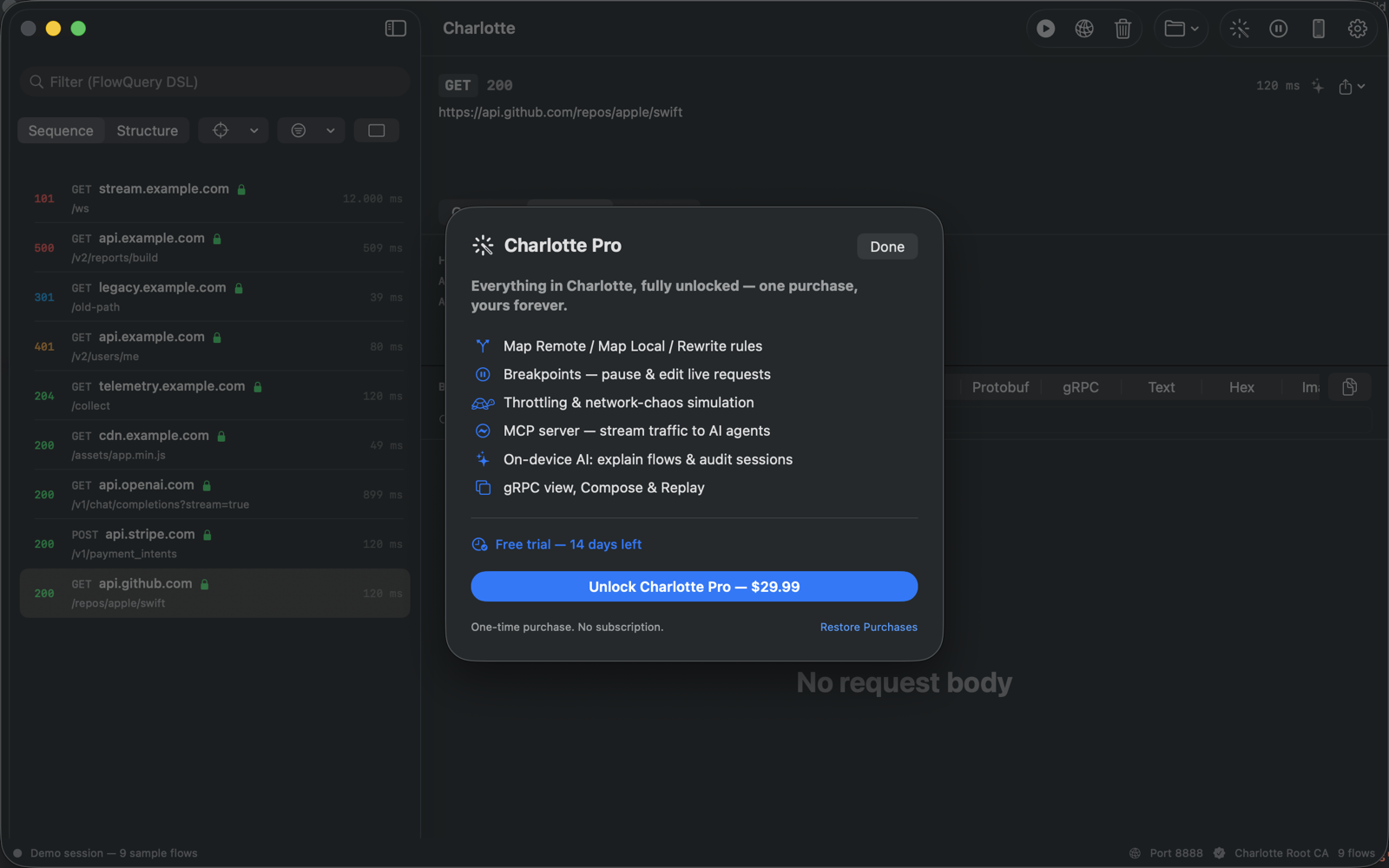
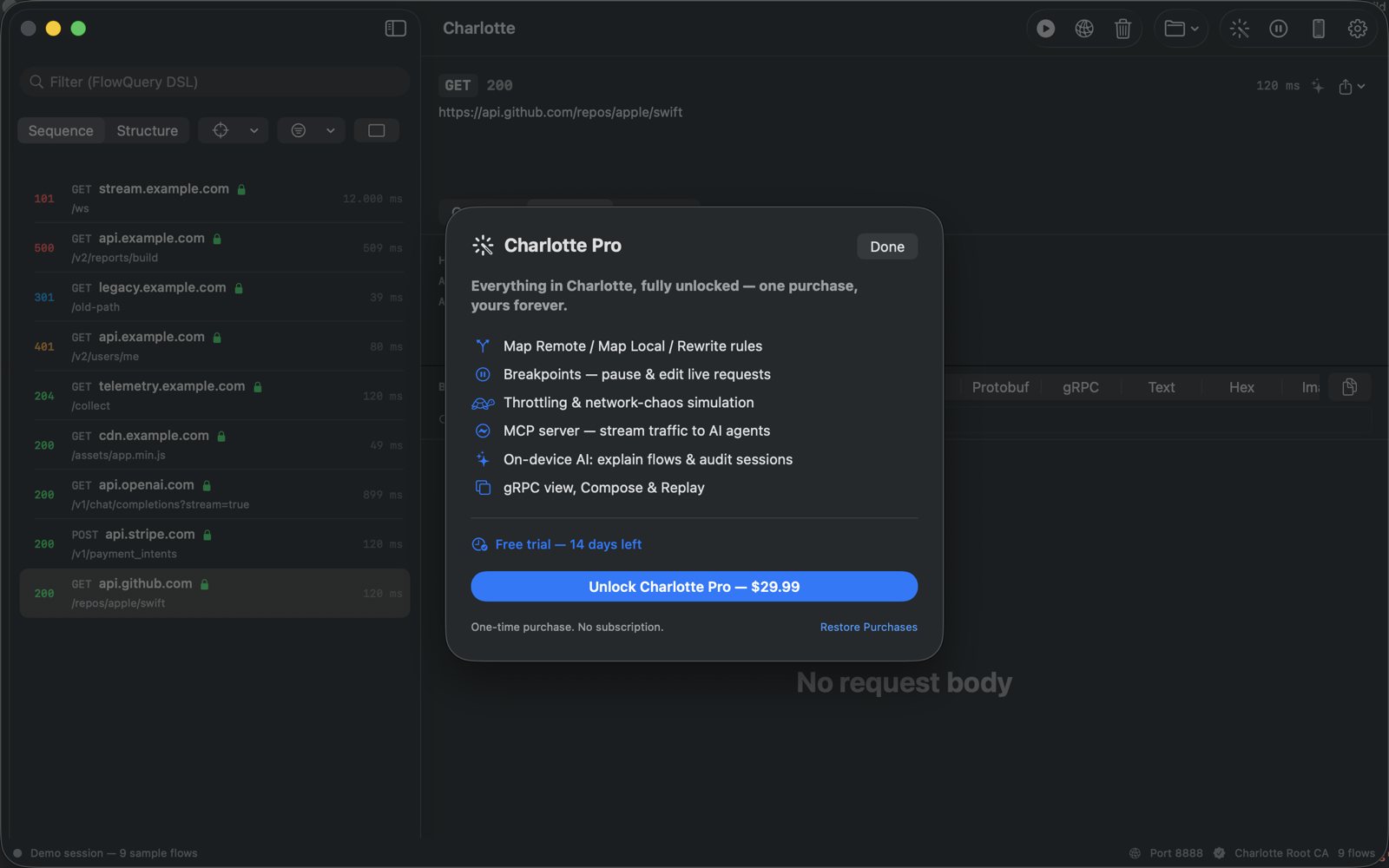
Map Remote, Map Local, and Rewrite rules. Set breakpoints to pause and edit live requests and responses.
Add latency, cap bandwidth, and randomly drop connections to test how your app behaves on flaky networks.
Explain a flow and flag anomalies or security issues with Apple's Foundation Models. Traffic never leaves your Mac.
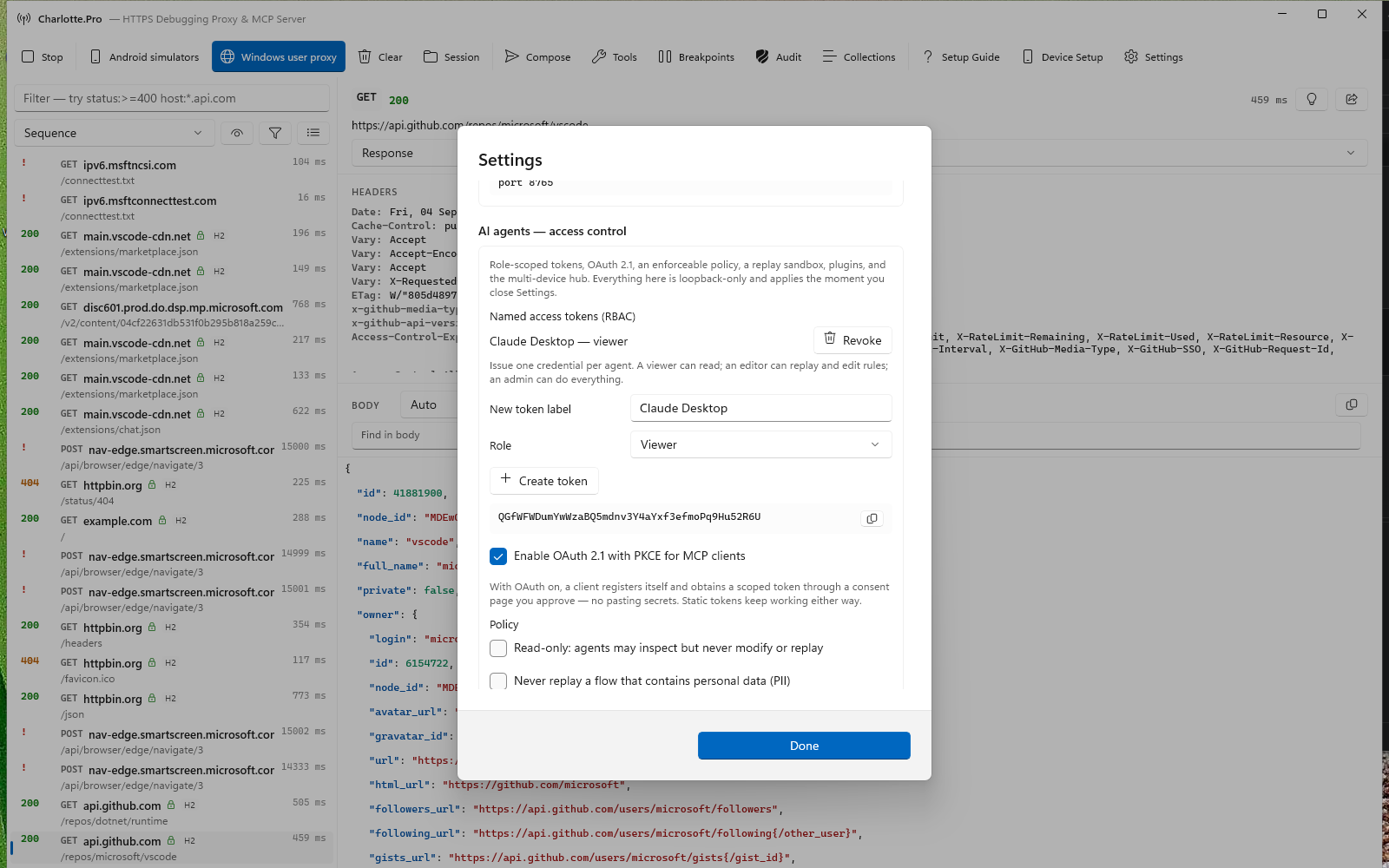
Expose captured traffic to AI agents (Claude, Copilot, …) over a local, loopback-only Model Context Protocol endpoint, gated by an access token you hand out yourself. How it works →
Give each agent its own token with a role — Viewer, Editor, or Admin — or let it sign in with OAuth 2.1 and PKCE. Add a policy to keep agents read-only or block PII replay, and a sandbox that blocks cloud-metadata addresses. Read more →
Native sessions, HAR 1.2, and copy-as-cURL — move your captures wherever you need them.
The Windows app is what ships today; the macOS build shares the same request-centric workflow and is coming soon.
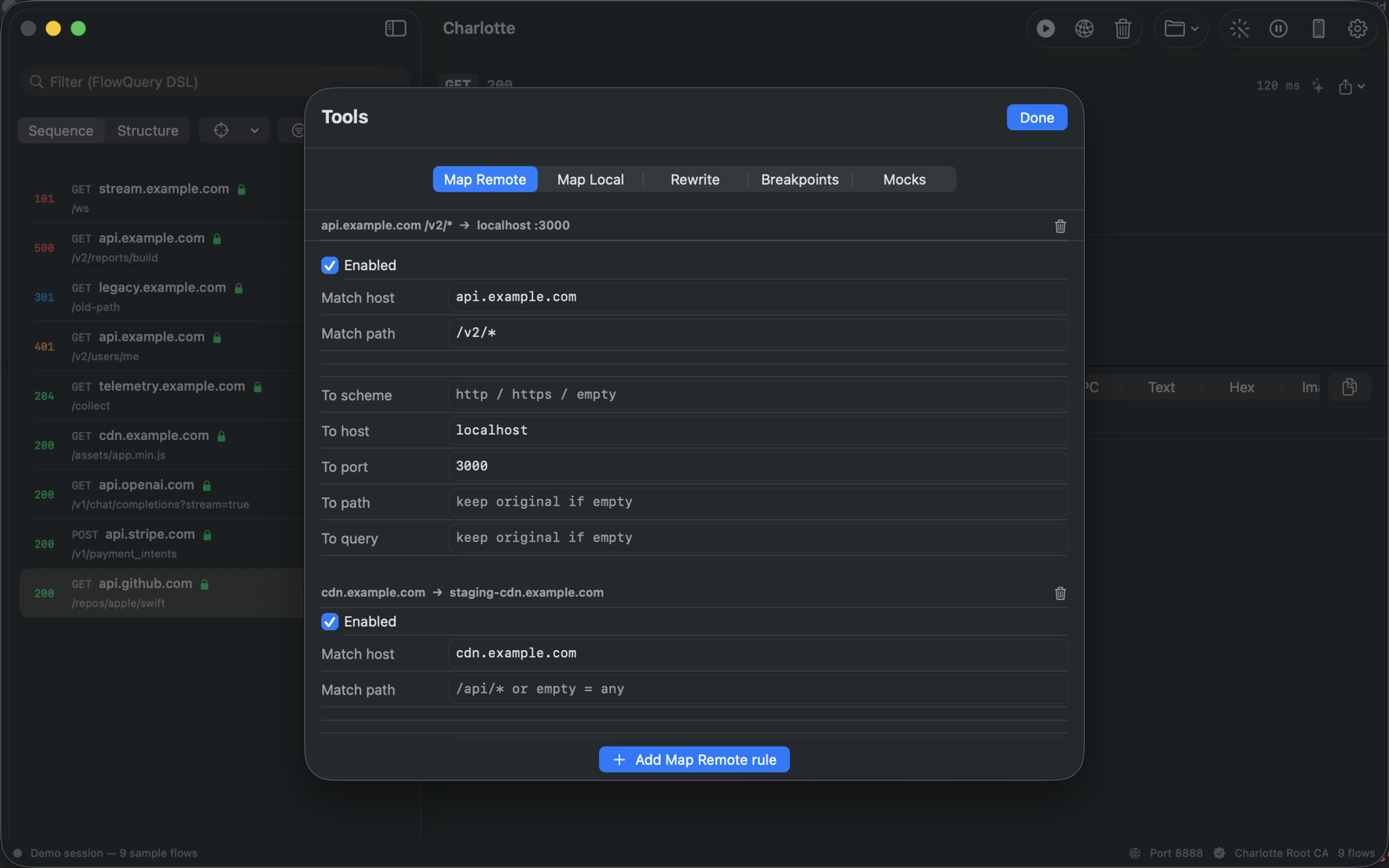
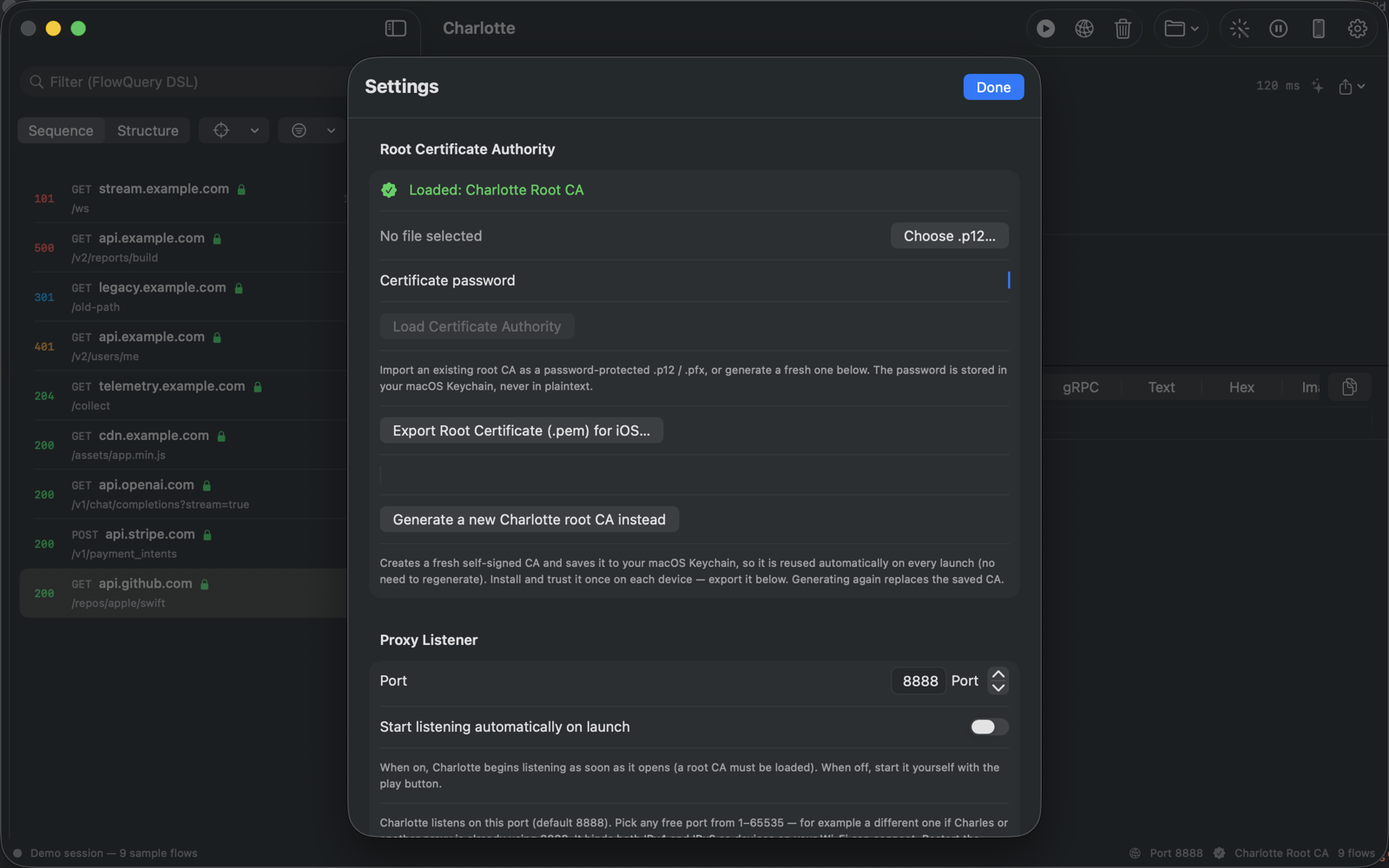
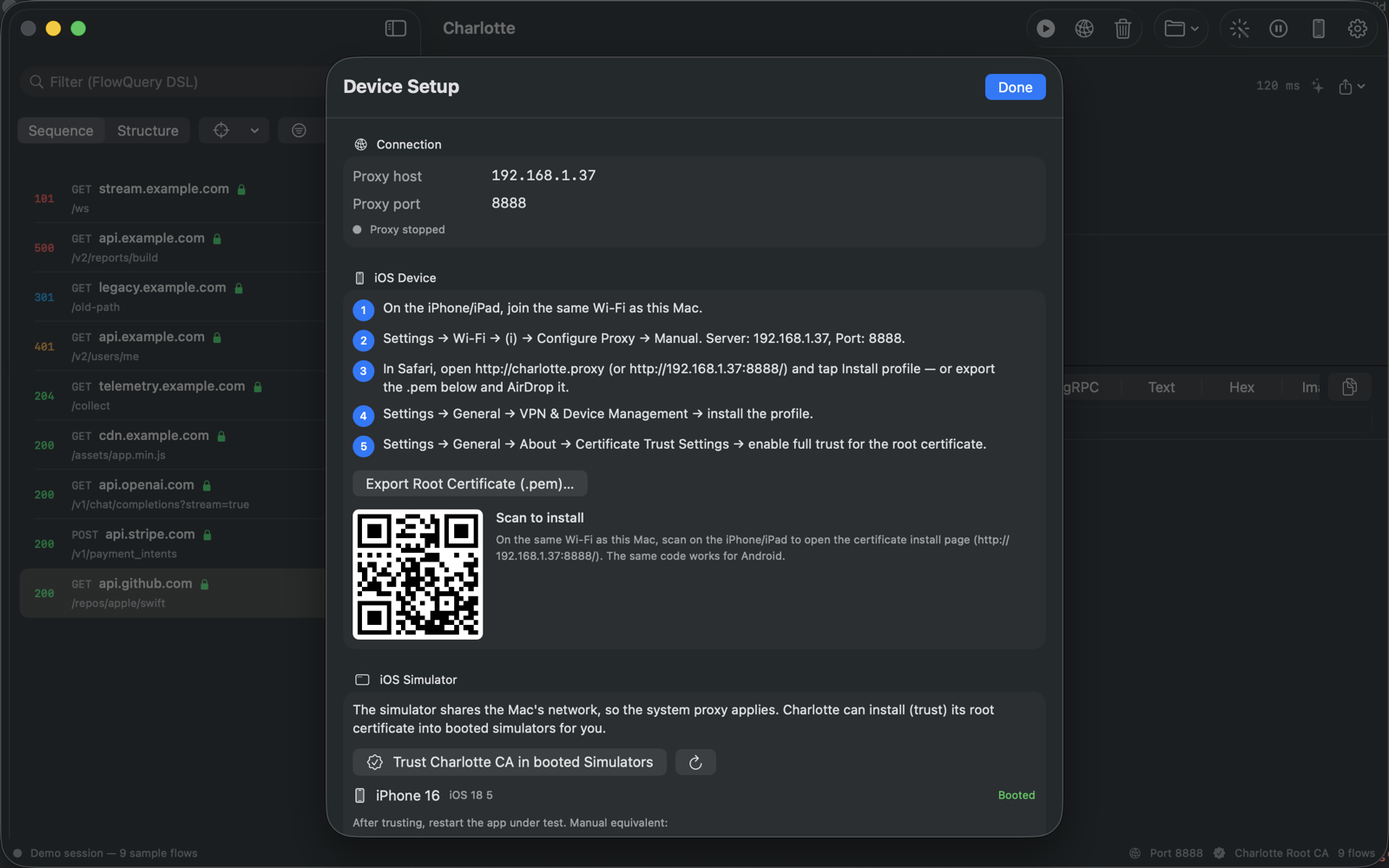
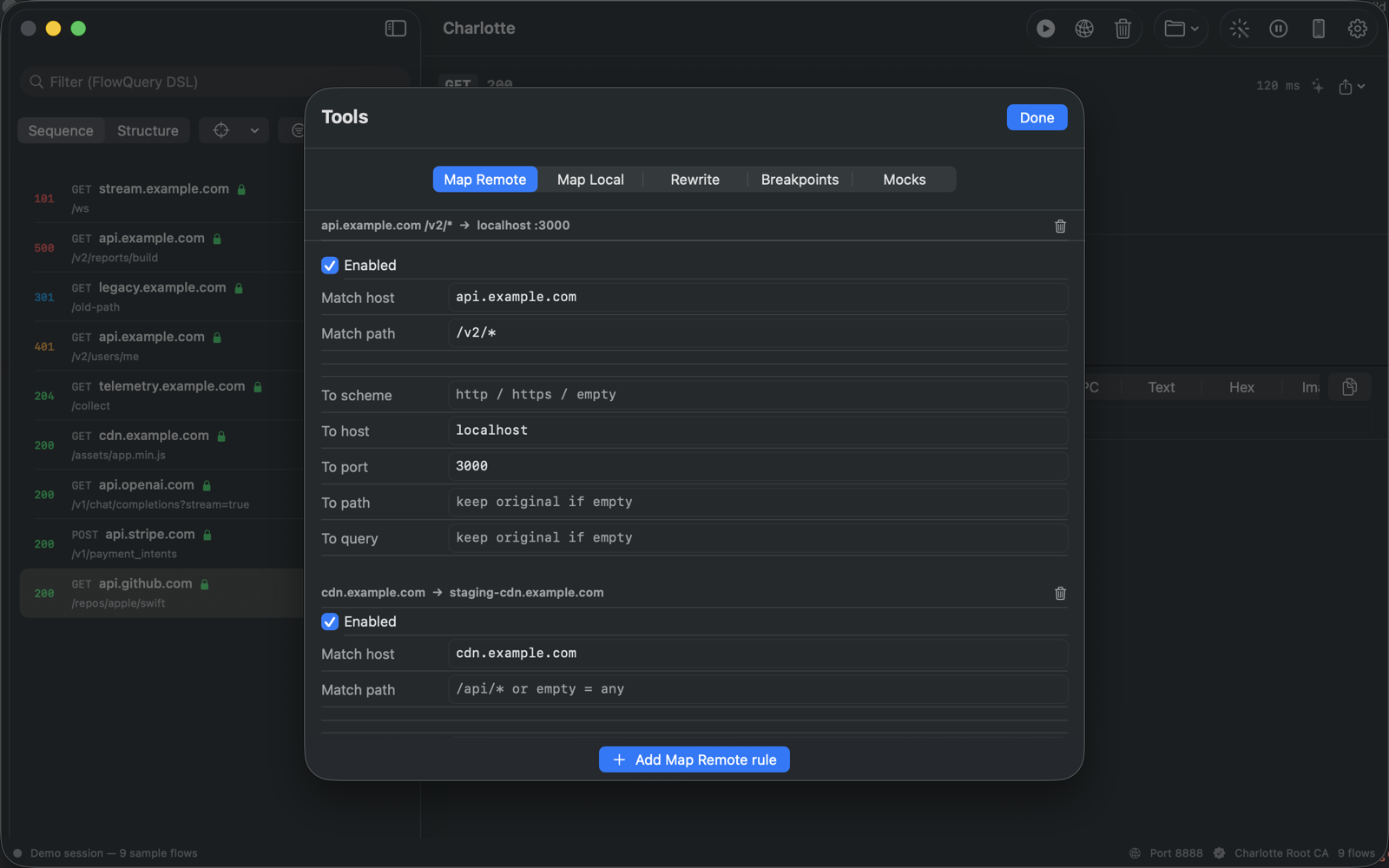
HTTPS can't be read from raw packets — so Charlotte terminates TLS as a proxy.
Generate a Charlotte root CA (saved to your Keychain) or import your own as a password-protected .p12.
Set your Mac's system proxy, or use guided setup for iOS, the Simulator, and Android.
Select any request to see headers and body. Rewrite, replay, breakpoint, or ask the on-device AI to explain it.
A tool that decrypts your traffic owes you a plain account of what it touches.
There is no Charlotte server, no telemetry, no analytics and no account. Captures stay in memory unless you export them yourself, and the AI features run on-device with no cloud fallback. Full privacy policy →
On Windows it saves its root certificate and opens Windows' own certificate window; you run the import, choose the store, and answer Windows' security warning. The app has no code path that writes to a certificate store.
The MCP server is off by default, binds to loopback, and requires an access token you copy from Settings — so no other program on your PC can read your traffic just because the server is running. Passwords, tokens and cookies are hidden from agents by default, and write tools stay off until you enable them.
Outside its own folder Charlotte changes your per-user proxy setting and your trusted root certificates, and only after you ask it to. The proxy is restored every time you quit, and Settings ▸ Before you uninstall puts both back in one click before you remove the app.
Charlotte.Pro is on the Microsoft Store. Free for 14 days with every feature unlocked — no account, no card. Then one payment, owned forever.
Or from a terminal: winget install --id 9PD5RZKFCM19 --source msstore
macOS version coming soon.
Built for software developers and QA personnel who need clear, repeatable network debugging.